How to Structure a 60-Minute Music Practice Session
An hour of practice is only a container. Give each part of the hour a job and it becomes easier to hear what is changing.
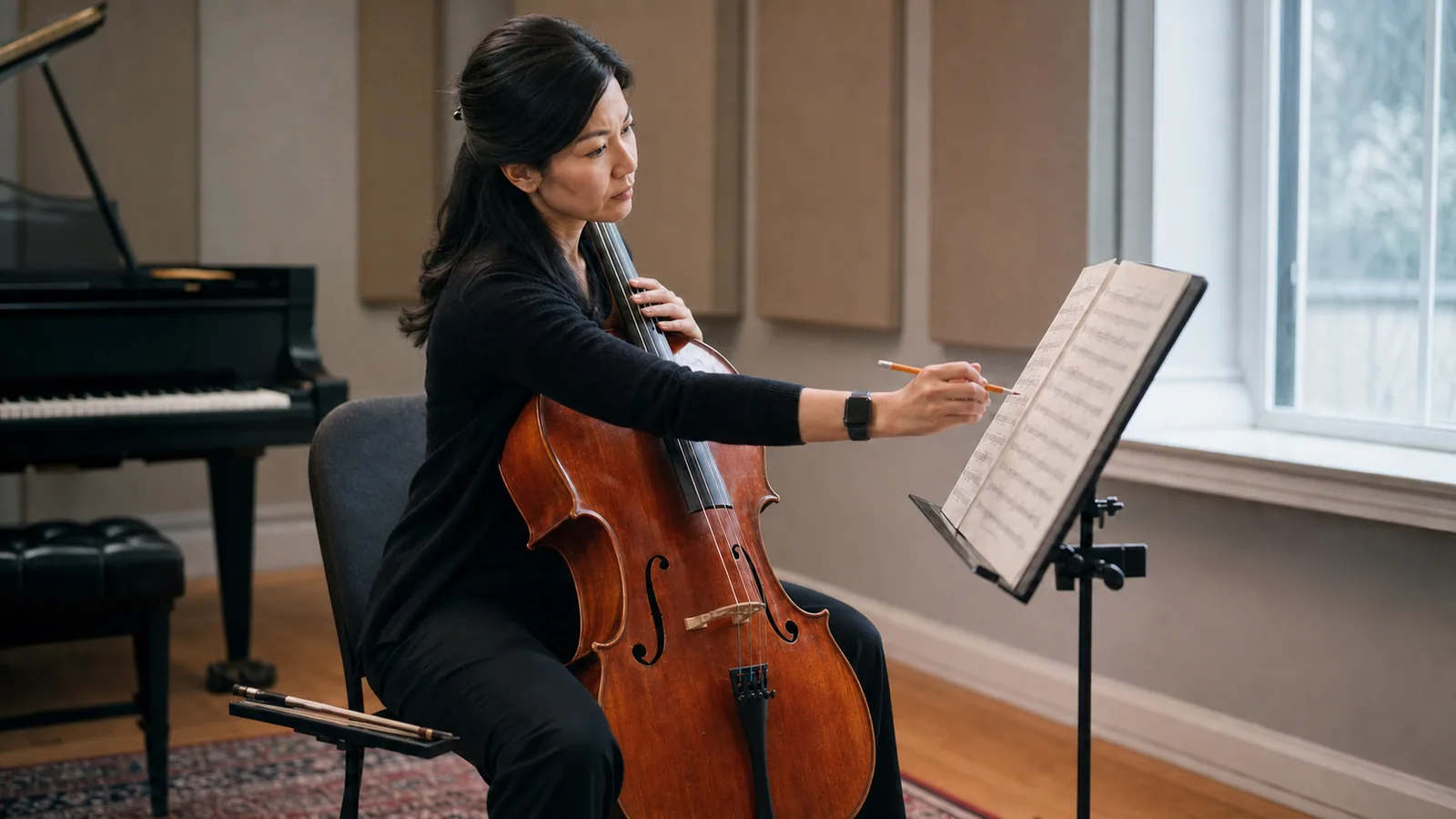
Scope note: Adjust duration, volume, posture, and rest to your age, instrument, training, and health. Stop if you experience pain, and seek qualified instruction or health guidance when needed.
One hour needs a musical question
An hour can disappear into playing from the beginning, restarting after mistakes, and revisiting favorite passages. Before the first note, choose one main question. It might be how to make a shift reliable, shape a phrase across a breath, stabilize a rhythm, or connect two sections at tempo.
Research does not support a simple equation in which accumulated practice hours explain all musical achievement. A meta-analysis found deliberate practice related to performance while accounting for a meaningful but limited share of variation across studies. Quality, history, instruction, opportunity, and other factors matter too.[1]
Write the question and the evidence you want by the end: three accurate connections at a chosen tempo, a recording with an audible dynamic plan, or a fingering you can explain and repeat. Now the hour has a purpose that can guide its blocks.
Minutes 0 to 10: arrive and prepare
Use the opening to set up the body, instrument, room, and ears. Tune carefully, check posture, and begin with comfortable sound. A warm-up should connect to the day's music rather than become an automatic obstacle course that consumes the session.
Choose one technical element that appears in the target passage. A wind player might prepare the articulation pattern on a simple scale. A pianist might explore the hand shape slowly. A string player might isolate the shift distance without forcing speed. Keep volume and repetition reasonable.
NAfME's music-major handbook stresses effective, self-directed practice and attention to physical health, including hearing and musculoskeletal concerns. Students should also follow the expectations of their teacher, program, and instrument-specific training.[2]
Minutes 10 to 25: diagnose the hard passage
Play enough context to identify the failure, then stop. Name what happened. Was the rhythm unclear, the motion inefficient, the harmony unfamiliar, the breath late, or the listening target absent? "I missed it" is an observation, not a diagnosis.
Reduce the passage until the problem becomes visible. That may mean two beats, one shift, separate hands, a spoken rhythm, or a slower tempo. Keep the musical intention present even at low speed. Accurate mechanics without the intended sound can teach a version you do not want.
Use short repetitions separated by evaluation. After each attempt, say one thing to keep and one thing to change. Mindless repetition can make the mistake more familiar. Deliberate repetition has a target, feedback, and a reason for the next attempt.
Minutes 25 to 35: connect and vary
Once the small unit improves, reconnect it to what comes before and after. Start one measure earlier, then two. Practice arriving from different entry points. A passage that works only when launched from the same spot is not yet dependable in performance.
Vary one dimension. Change tempo slightly, alter rhythm for technical clarity, play softer, or remove a support and restore it. Variation tests whether the solution is flexible. It should not become novelty for its own sake. Return to the written music and intended interpretation after each experiment.
Auditory feedback is central to musical motor learning. Experimental research with pianists has examined how altered or absent feedback affects learning, illustrating that what players hear helps shape movement and prediction. Recordings and careful listening can therefore reveal more than physical repetition alone.[3]
Minutes 35 to 48: restore the music
Play a larger section without stopping at the first imperfection. The goal now is continuity, phrasing, balance, and recovery. Mark what happens but preserve the line. Performance requires both precise local work and the ability to continue when something is not ideal.
Make one recording from a useful distance. Listen without playing along. Write three specific observations: one about rhythm or accuracy, one about sound, and one about structure. Avoid a global verdict such as "bad." A recording is evidence for the next decision, not a referendum on the musician.
Return to only the highest-value issue the recording revealed. If it matches the day's main question, test the correction once or twice. If it is a new large problem, put it on tomorrow's list rather than allowing it to consume the closing phase.
Minutes 48 to 56: perform a complete unit
Choose a complete movement, song, excerpt, or section that fits the remaining time. Announce the intention, begin, and continue to the end. Treat the run as information. If the work is not ready for a complete performance, use a shorter but musically whole unit.
Notice recovery. When attention slips or an error occurs, can you find the pulse, breath, harmony, or ensemble role again? Practicing recovery reduces the all-or-nothing habit of restarting. It also exposes places where memory depends on a single chain with no alternate entry.
Do not squeeze in repeated full runs because the timer shows eight minutes. One attentive run followed by useful notes is better than three exhausted passes. Protect hearing, coordination, and tomorrow's capacity.
Minutes 56 to 60: leave a clear trail
Use the final cue to stop playing and write. Record what changed, the tempo or condition that worked, and the exact place to begin next time. Put markings in the score while their meaning is fresh. Save the recording with a useful name if you plan to compare it.
Return the instrument and room to a safe state. Follow appropriate care, storage, volume, and hearing-protection practices. A rushed cleanup can damage equipment or make the next session harder to start.
The sixty-minute shape is adjustable. A beginner, young student, vocalist, recovering player, or professional preparing a long program may need a different duration and more breaks. Keep the architecture: arrive, diagnose, connect, make music, and leave a trail.
Adapt the hour when the plan meets reality
The clock will sometimes reveal that the chosen question is too large. If fifteen minutes pass and the cause of a problem is still unclear, narrow the target. Compare two fingerings, clap one rhythm, sing one line, or bring the question to a teacher. An hour should create a useful next step even when it cannot create a finished solution.
On another day, the passage may improve sooner than expected. Do not fill the remaining block with automatic repetition. Test the result after a short pause, enter from a different place, or place it in musical context. If it remains stable, move on. Knowing when a problem is sufficiently prepared is part of practicing well.
Ensemble music needs a parallel plan. Spend individual time on entries, pulse, cue awareness, and the lines you respond to, not only your own notes. Mark where another part supplies harmony or motion. This lets the next rehearsal begin with listening rather than personal repair.
For performance preparation, vary the final run across days. Start cold once, record from a distance, practice after a realistic break, or perform for one trusted listener. Keep the conditions safe and relevant. The purpose is to find out whether the musical choices survive outside the exact routine that created them.
When the hour contains several pieces, assign each one a different kind of work. One may need slow technical repair, another a complete memory run, and another only a brief maintenance pass. Equal minutes are not automatically fair or useful. Give the largest block to the musical question with the greatest consequence and clearest path forward.
Keep a short weekly view beside the daily notes. It can show which repertoire received complete runs, which skills were revisited, and when recovery or lighter playing is planned. This prevents one urgent passage from consuming every session while other music quietly becomes less secure.
If a teacher assigns a different structure, use that structure and bring back precise observations. Report the tempo where control changed, the entry that failed after a pause, or the sound you could not reproduce. Specific evidence lets instruction address the real problem more efficiently than a report that you practiced for an hour.
References
- [1] The Influence of Deliberate Practice on Musical Achievement: A Meta-Analysis. Frontiers in Psychology via PubMed.
- [2] Music Major Student Handbook, Chapter 3. National Association for Music Education.
- [3] The Role of Auditory Feedback in the Motor Learning of Music. Scientific Reports via PubMed.
Related articles
Music Practice
Silent Timing for Rehearsals and Recording Sessions
Use quiet timing cues to manage takes, rehearsal blocks, breaks, and handoffs without adding another audible interruption to the room.
Read the articleCooking & Baking
Bread Proofing Timers: Why Temperature Matters as Much as Time
Use time as one clue, not the verdict, when proofing bread. Learn how dough temperature, room conditions, and observation work together.
Read the articlePut quiet timing on your wrist
Get Haptica: Silent Watch Timer from the App Store and build timing cues that fit your routine.
Get Haptica on the App Store